
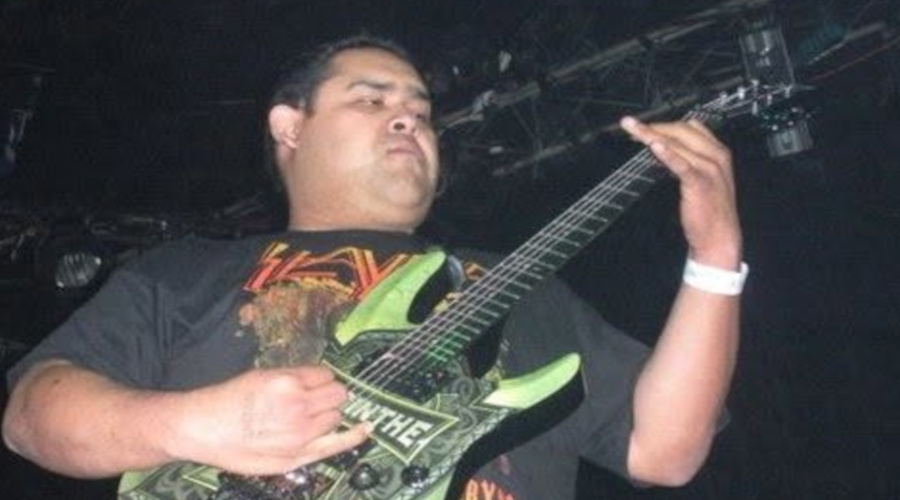
Interview with Gene Olivarri founder/guitarist of Dirigiri
Interview by Fury
Date: September 16, 2026
Founded in San Antonio, Texas, in 2004 by guitarist Gene Olivarri, Dirigiri has spent more than two decades developing what Olivarri describes as Extreme Texas Death-Thrash—a blend of extreme thrash, death metal, groove, and technical guitar work rooted in the Texas underground.
The band’s sophomore album, Cursed Masters, brings that identity together across five tracks: “Holy Perversion,” “Cursed Masters,” “Burned at the Stake,” “Creature of Sin,” and “Bury Your Dead.” The record combines dark historical and psychological themes with aggressive riffing, fast picking, groove, and a deliberately human guitar performance.
Olivarri’s approach to the instrument is equally uncompromising. He performs on a 7-string Schecter Omen Elite-7, uses Ernie Ball strings, and is endorsed by InTune Guitar Picks, relying on their GripX .73mm model. His playing and recording philosophy emphasizes a direct, full-analog approach and preserving the physical dynamics of a real guitar performance.
Metalhed: Gene, thank you for sitting down with us today. You’re the founding guitarist behind the extreme Texas Death/Thrash band Dirigiri. First off, congratulations on Cursed Masters. What does this album mean to you personally?
Gene Olivarri: Cursed Masters means a lot to me because it’s more than just another album. It’s a document of where Dirigiri has been, what we’ve survived, and how far we’ve pushed our sound since the band began in 2004. Every riff, every lead, and every track represents years of work, experience, frustration, and determination.
For me, the album is about keeping something real alive. I didn’t want Cursed Masters to sound like a computer constructed it. I wanted the listener to hear the human being behind the guitar—the attack, the dynamics, the imperfections, and the emotion. The songs deal with dark subjects, historical tragedy, psychological torment, and the uglier sides of humanity, but underneath all of that is the story of Dirigiri itself.
This record also represents what I believe Texas Death/Thrash can be. We aren’t trying to copy another scene or follow whatever is popular. We’re taking the influences we grew up with and pushing them through our own Texas identity. So when I listen to Cursed Masters, I hear a piece of our history. That’s what makes the album special to me.
Metalhed: The name Dirigiri has long been associated with the idea of a funeral dirge or “hymn of death.” When you formed the band in 2004, did you choose the name because you knew the band’s lyrical direction would be tied to human tragedy and historical horror?
Gene: Absolutely. From day one, I didn’t want us to write about cartoonish gore or basic shock tactics. The name “Dirigiri” represents a hymn of death. History is the greatest horror story ever written, and real-life tragedies provide a far darker canvas than anything you can make up.
Metalhed: You’ve proudly called San Antonio the heavy metal capital of America. In the early 2000s, what regional hurdles did you have to overcome to establish your Texas Death/Thrash identity?
Gene: Back then, you had to fight for every inch of stage space. San Antonio always loved classic metal, but when we started injecting blast beats and the structural weight of death metal into a thrash blueprint, it confused people at first.
We had to build our scene brick by brick. We didn’t try to sound like New York, Florida, or California. We wanted a harsher, more aggressive sound that was native to South Texas.
Metalhed: Dirigiri pushed its early material through independent marketing and grassroots distribution. How did that DIY period shape the way you approach music today?
Gene: When you’re paying for your own material and packages, printing your own flyers, and hunting down global zines, radio stations, and record labels yourself, you don’t waste time. You just do it day in and day out.
That urgency and hunger never left me, even with Kaspearia Promotional Management involved. Neither of us backs down.
Metalhed: You’ve been vocal about running a full-analog, no-pedal approach. In a modern world dominated by digital modelers and profiling gear, why is that raw tube-and-wire connection so important to Dirigiri?
Gene: Digital modelers are convenient, but to my ears, they flatten the natural dynamics. They lack that “thump.” When I dig into my 7-string, I want to hear the actual wood fighting the tubes. I want those micro-imperfections of real analog electricity. A real amplifier pushes physical air against your spine on stage, and that’s an energetic transaction digital code can’t replicate.
Metalhed: You’re using a Schecter Omen Elite-7 as your 7-string. What does that extended-range instrument give you that works particularly well for Dirigiri?
Gene: The extra string gives me another range to work with. That low B allows me to build heavier riffs while keeping the feel and attack of the guitar.
For Dirigiri, the seventh string isn’t just there to make things lower. It’s another part of the songwriting vocabulary. I can use it for those heavy rhythmic foundations and then move into the higher strings for leads, harmonies, and dissonant intervals.
Metalhed: High-speed technical tracking on a 7-string can get muddy instantly. How do you adjust your preamp gain so the low-B staccato notes hit like concrete blocks rather than becoming a continuous wash of distortion?
Gene: The secret is to turn the gain down. If you turn your gain up to nine or ten, the compression ruins your articulation and the low B turns into a giant cloud of white noise.
I keep my amp gain around five or six. I let the raw velocity of my right-hand pick attack create the perceived distortion. If you pick hard with lower gain, the notes retain their separation and punch through the snare drum.
Metalhed: Traditional thrash often glorified the scooped-mid EQ. Why is scooping your mids a mistake when balancing a 7-string against rapid blast beats?
Gene: Scooped mids look cool on a graphic EQ slider when you’re playing alone in your garage. But the second a drummer hits a blast beat, a scooped guitar disappears from the mix.
The guitar lives in those mid frequencies. I bump my high mids so the 7-string can cut through the cymbals and find its pocket above the bass.
Metalhed: How do you balance Treble against Presence so the pick attack stays razor sharp without making the high strings screech?
Gene: I treat Treble as the overall brightness and Presence as the actual click of the pick. I keep the Treble around six so the high register stays thick. Then I can push Presence to around 7.5.
That creates a high-end transient every time my pick touches an Ernie Ball string, making rapid alternate picking highly audible.
Metalhed: Where do you set the amplifier’s resonance or deep control to keep the low end under control with a 7-string?
Gene: I keep the resonance strictly below noon. If you push the low-end cabinet resonance too hard, the 4×12 speakers start vibrating at the same sub-frequency as the low B.
That can cause an awful low-frequency hum on stage. I let the bass player anchor the sub-lows while the guitar cabinet focuses on punch and mid-bass.
Metalhed: You’re endorsed by InTune Guitar Picks and rely heavily on their GripX .73mm model. Many death-metal players prefer rigid 2.0mm picks. Why does a thinner pick work for you?
Gene: People look at my pick gauge and think I’m crazy for playing death-thrash with it.
But a rigid 2mm pick acts like a wall when it hits a thick .072 string. It resists you and can create wrist tension. The GripX .73mm has just enough microscopic flex to slide over the string like a shock absorber. It snaps back instantly and allows me to move across seven strings with less physical resistance.
Metalhed: When transitioning from a standard down-picked riff to rapid tremolo on the heavy 7th string, how do you adjust your pick angle?
Gene: You can’t hit the 7th string completely flat with the face of the pick or it can snag and ruin your timing.
I tilt my hand so the pick slices the string at roughly a 45-degree angle. That minimizes the surface area of the plastic hitting the string and lets it glide through the heavy gauge while retaining a bright attack.
Metalhed: At tempos exceeding 200 BPM, how deep does the tip of the pick actually travel through the strings?
Gene: Less than a single millimeter.
If your pick digs any deeper than the absolute tip, you’re creating unnecessary physical travel. At high tempos, extra distance equals death. I train my right hand to brush across the very top of the string. It takes control, but it’s the most efficient way to maintain rhythmic tracking without fatiguing the forearm.
Metalhed: You’re using Ernie Ball strings, with heavy gauges such as a .054 and .072 on the bottom end. How do those gauges help prevent the low B from flubbing out or going sharp during heavy downstrokes?
Gene: Standard 7-string sets can be too loose on the bottom. If you hit a thin low string hard, it physically deflects and can pitch sharp before settling back down. By stepping up to a heavy .072 for the 7th string, the structural tension remains rock solid. It gives immediate recoil under a violent downstroke and keeps the pitch and transients much more controlled.
Metalhed: With an extra string, sympathetic vibrations become a nightmare. What parts of your fretting hand do you use to mute unplayed strings?
Gene: Muting is 50 percent of the battle.
My fretting index finger acts like a permanent dampener. While the fingertip frets the note, the fleshy underside can rest lightly across higher unplayed strings. At the same time, the side of my right-hand thumb dampens the lower strings. It’s a constant push-and-pull cage match to keep the instrument quiet.
Metalhed: What’s your step-by-step metronome routine for building picking stamina?
Gene: I treat it exactly like weight training. I set the click to a moderate, comfortable tempo and down-pick straight eighth notes on a muted low B for three minutes without stopping. The key is monitoring your body. The second I feel my wrist or shoulder clenching, I stop, drop the tempo by ten BPM, and focus on playing completely loose. Relaxed muscles build endurance; tense muscles cause problems.
Metalhed: When mapping a highly syncopated rhythm for Hymns of Death, do you practice against a standard quarter-note click or subdivide it?
Gene: When a riff features odd rests or complex off-beat syncopations, a standard quarter-note click can leave too much empty space where you can rush or drag.
Subdividing the click gives you a tighter audio safety net. Once the muscle memory is flawless, I turn off the subdivision and return to quarter notes so I can learn to let the riff breathe.
Metalhed: At what point do you mathematically allow yourself to increase the tempo?
Gene: My personal rule is ten perfect repetitions in a row. If I play a complex technical lead nine times flawlessly but clip a wrong note or buzz a string on the tenth, I stay at that tempo. I also look at my breathing. If I’m holding my breath or gritting my teeth to hit the tempo, I’m not ready to increase it.
Metalhed: To break through a mechanical speed plateau, do you use short speed bursts or long-duration endurance loops?
Gene: I use speed bursts. If a phrase is comfortable at 190 BPM but I want to reach 210, I’ll play a four-note fragment of that riff at 210 and then rest for a measure. That trains the brain and neurological pathways to understand what the higher velocity feels like without exhausting the muscles over a long loop.
Metalhed: Cursed Masters is notable for its natural, un-triggered guitar delivery. How hard did you have to fight in the studio to preserve those human dynamic variations?
Gene: I fought like hell for it. Modern metal production can involve copy-pasted sections and guitars edited perfectly to a mechanical grid until they sound like a MIDI file. For Cursed Masters, we wanted the listener to hear a human being pushing the strings down. If a transient was a little off but had incredible energy and attitude, we kept it. That organic push and pull gives the music danger.
Metalhed: Let’s return to “Holy Perversion.” The opening track establishes a blisteringly fast tone immediately. Mechanically, how did you structure the 7-string rhythm pattern so it hooks the listener without overwhelming the mix?
Gene: The goal was immediate sonic violence. I structured the main riff around sudden staccato stops. By leaving tiny pockets of absolute silence between the fast-picked notes, Travis’s snare can pop out like a gunshot. It’s that contrast between intense guitar noise and dead silence that hooks the brain.
Metalhed: On the title track, “Cursed Masters,” you move between high-velocity thrash picking and crushing halftime sections. How do you physically prepare your right hand to make that transition?
Gene: It’s about shifting your weight distribution. During the fast thrash sections, my wrist is floating lightly and using minimal energy. When we drop into the heavy halftime section, I dig my palm into the bridge area to damp the strings and switch to heavier downward forearm strikes. It’s like going from a fencing foil to a sledgehammer in a split second.
Metalhed: The lead work on “Burned at the Stake” feels sophisticated and narrative-driven rather than being shredding for the sake of shredding. What was your musical approach?
Gene: I wanted the lead to mimic the panic and tragedy of the lyrical theme. Instead of simply running minor pentatonic shapes up and down the neck, I used Phrygian-dominant and diminished ideas. Those intervals create an old-world, ominous tension that tells a darker story over the rhythm.
Metalhed: “Bury Your Dead” is one of the most physically demanding tracks to execute cleanly. What makes the guitar part so difficult, and how does “Creature of Sin” contribute to the overall five-song structure of Cursed Masters?
Gene: “Bury Your Dead” requires rapid-fire triplet chugs on the low 7th string and then an immediate jump to the 4th and 3rd strings for dissonant dyads. Skipping over dead strings at that speed while keeping everything isolated requires a lot of left-hand muting precision.
With “Creature of Sin,” I wanted another identity within the record. I don’t want five songs that sound like the same riff repeated. Each song needs its own atmosphere while still fitting the Dirigiri sound.
The five songs together are supposed to feel like a complete record rather than simply a collection of tracks.
Metalhed: You’re deep into the writing phase for the next album, Hymns of Death. How are you pushing the structural limits of your 7-string beyond Cursed Masters?
Gene: On Hymns of Death, the tempos are significantly faster, but the arrangements are also more labyrinthine. I’m experimenting with odd polyrhythmic ideas on the low 7th string while the drums maintain a straight thrash beat underneath. It creates a jarring, heavy tension that feels chaotic but remains hyper-controlled.
Metalhed: Thrash metal relies heavily on dissonant intervals such as tritones and minor seconds. How do you put those sounds into the lowest register of a 7-string without creating mud?
Gene: The trick is avoiding huge multi-note chords down that low. I write those minor-second and tritone relationships as rapid, single-note or linear riffs. By separating the notes and using razor-sharp palm muting, the dissonance stays terrifyingly heavy and sharp instead of becoming a muddy wall of sound.
Metalhed: Gene, thank you for giving us the unfiltered truth behind Dirigiri—the history, the five tracks on Cursed Masters, your Schecter 7-string, Ernie Ball strings, InTune GripX .73mm picks, the analog amplifier philosophy, and the technical work behind the music. What final message do you have for the fans?
Gene Olivarri: Thank you for having me. Thank you to all our fans and the metal family, and thank you to our management, Kaspearia Promotional Management who works extremely hard. Horns up to everyone keeping real, independent Texas metal alive. Keep your eyes peeled for the new record. We’ll see you on the road!
Metalhed: Gene Olivarri of Dirigiri. More than two decades of Texas extreme metal, Cursed Masters in the books, and Hymns of Death on the horizon. Horns up!
Gene Olivarri: Horns up!
Links: Dirigiri FB page: Dirigiri Official
Bandcamp: Dirigiriofficial.bandcamp.com
Instagram: https://www.instagram.com/the_hackolantern
YouTube: https://youtube.com/@geneolivarri
Booking and social media contact: Kaspearia Promotional Management